
Punjab Police | Updated 20 October 2026
Amritsar Police FIR Online Registration and Complaint Guide
How to report a crime or submit a police complaint in Amritsar, what the law requires for registering a First Information Report (FIR), and how to request a copy or follow up on your case.
What is an FIR?
A First Information Report (FIR) is the formal police record of information about a cognizable offence. A cognizable offence is one for which police may arrest without a warrant, as provided by law. The procedure for recording such information is principally governed by Section 173 of the Bharatiya Nagarik Suraksha Sanhita, 2023 (BNSS), in force from 1 July 2024. The earlier corresponding provision was Section 154 of the Code of Criminal Procedure, 1973.
How to submit a complaint to Amritsar Police
- Identify the correct police service. Start with the Punjab Police official website or the Government of Punjab portal for current service and contact information. The older Amritsar City Police complaint-box address reproduced in earlier versions of this guide should not be relied upon without verification.
- Choose the complaint or grievance facility where available. The Punjab Government also provides an online grievance management service. A departmental grievance is not necessarily a registered criminal FIR.
- Provide complainant details. Enter your full name, phone or mobile number, postal address, city, state and email address as requested by the applicable form.
- Provide details of the person complained against, if known. Include their name, contact number, address, city and state. If the identity is unknown, describe the person or circumstances accurately rather than guessing.
- Describe the incident. Include the date, time, location, what happened, witnesses, property or injuries involved, and available supporting material. Choose an appropriate subject such as theft, snatching or another incident type.
- Submit and preserve the acknowledgement. Complete any security verification and save the complaint reference number, receipt, email or screenshot. If a cognizable offence is disclosed, request confirmation of FIR registration and the FIR number.
Original Amritsar Police complaint-box illustrations
The following historical screenshots are retained to explain the earlier online complaint workflow. They may not reflect the current live portal.
Earlier Amritsar Police website navigation.
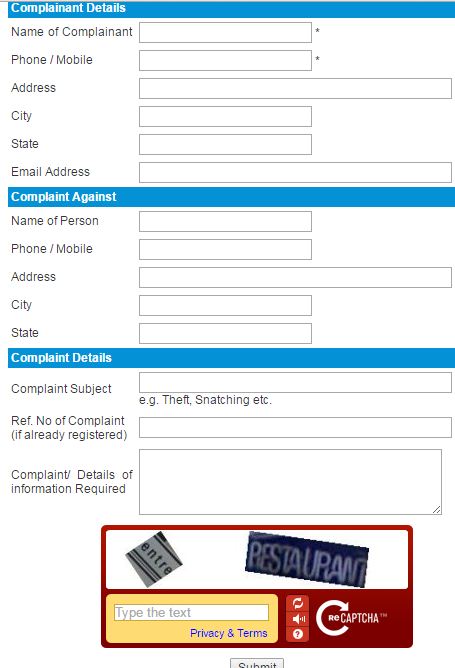
Earlier complaint form showing complainant, respondent and incident details.
Your rights under BNSS Section 173
Section 173(1): Recording information, Zero FIR and electronic reporting
Information about a cognizable offence may be given orally or by electronic communication to the officer in charge of a police station, regardless of where the offence occurred. This enables Zero FIR, where information may initially be recorded outside the territorial jurisdiction of the police station concerned. Information sent electronically is taken on record upon being signed by the informant within three days, as the law requires.
Section 173(2): Free copy of the FIR
A copy of information recorded under Section 173(1) must be provided forthwith and free of cost to the informant or the victim.
Section 173(3): Limited preliminary enquiry
For specified cognizable offences punishable with imprisonment of three years or more but less than seven years, the officer in charge may, with prior permission of an officer not below the rank of Deputy Superintendent of Police and considering the nature and gravity of the offence, conduct a preliminary enquiry within fourteen days to ascertain whether a prima facie case exists, or proceed with investigation.
Section 173(4): If police refuse to record information
A person aggrieved by refusal to record information about a cognizable offence may send the substance of that information in writing and by post to the Superintendent of Police concerned. If the statutory conditions are met, further recourse to the Magistrate is available.
Read the official BNSS text on India Code and the Ministry of Home Affairs criminal laws resource.
How to follow up and obtain an FIR copy
Retain the complaint acknowledgement and contact the receiving police station or relevant investigating officer. If an FIR has been registered, ask for the FIR number, date and police station. An informant or victim can request the free copy required by Section 173(2). Availability of public online FIR copies may depend on case type, disclosure restrictions and the applicable police system.
For investigation updates, Section 193(3)(ii) BNSS provides for informing the informant or victim of investigation progress within ninety days, including by electronic communication.
Frequently asked questions
Can I register an FIR from a mobile phone?
Information about a cognizable offence can be sent electronically under Section 173(1), subject to the signature requirement within three days. The exact online interface offered by Punjab Police may vary.
Is an online complaint the same as an FIR?
No. A complaint or grievance submission is not proof that police have registered an FIR. Obtain the FIR number and copy where applicable.
Can I report a crime outside Amritsar?
Yes. Section 173(1) allows information about a cognizable offence to be given irrespective of the place where it occurred, commonly called Zero FIR.
What if the accused person's details are unknown?
Provide the facts and any identifying description you actually know. Do not invent names or contact information.
Related case-law resources
This article provides general legal information. Police portals, contact details and procedural requirements may change; check official sources and seek qualified legal advice for individual matters.