
Jalandhar Police Online Complaint and FIR Registration: Complete Guide
Residents of Jalandhar, Punjab, can report incidents to the police through available citizen services or directly at a police station. This guide explains online complaints, FIR registration, the information to provide, and the rights of informants under current criminal procedure law.
Where to submit a Jalandhar Police complaint
Start with the official Punjab Police website and follow its current citizen services or complaint links. You may also contact the appropriate Jalandhar police station directly. Portal menus and login requirements can change; always use the current official website rather than relying solely on an old screenshot.
The older Jalandhar Police site was listed as www.jalandharpolice.gov.in, with a former online complaint page. These are historical references from the original guide and may no longer work. Use the Punjab Police website above for current access.
How to file a complaint online: step-by-step
- Open the official portal. Visit Punjab Police and locate the current online complaint or citizen service.
- Select the relevant district or police station. Choose Jalandhar and the jurisdictional station when the form asks for it. You may report cognizable offences irrespective of territorial jurisdiction under Section 173(1) BNSS.
- Enter your contact details. Supply your name, email, phone number and address as requested.
- Describe the incident accurately. State when and where it happened, what occurred, the names or descriptions of people involved (if known), witnesses, and any supporting records.
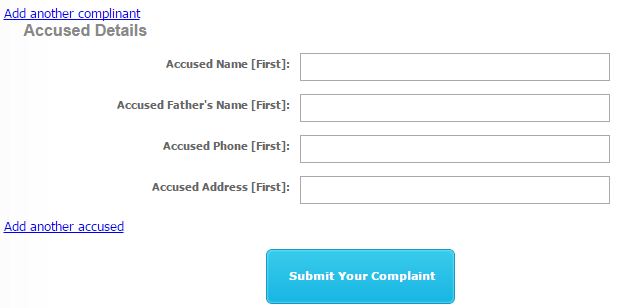
- Enter complainant and accused details. Older Jalandhar forms had fields for complainant name, father's name, phone, address, additional complainants, and accused name, father's name, phone, address and additional accused. Provide only information you know; do not invent unknown details.
- Review and submit. Save the acknowledgement or reference number, screenshot and any confirmation message. Submission does not guarantee that an FIR has been registered.
- Follow up. Ask the police station for the complaint outcome and FIR number where the reported facts disclose a cognizable offence.
Legal provisions governing FIR registration in 2026
The Bharatiya Nagarik Suraksha Sanhita, 2023 (BNSS) came into force on 1 July 2024, replacing the Code of Criminal Procedure, 1973 for new proceedings, subject to applicable transitional provisions. The relevant provisions include:
Section 173(1): Information about a cognizable offence
Information relating to the commission of a cognizable offence may be given orally or by electronic communication to the officer in charge of a police station, irrespective of where the offence occurred. Oral information must be reduced to writing and read over to the informant. Electronic information is taken on record when signed by the person giving it within three days, as the provision requires. The substance must be entered in the prescribed book.
Section 173(2): Free copy of recorded information
A copy of the information recorded under Section 173(1) must be given forthwith, free of cost, to the informant or the victim.
Section 173(3): Preliminary enquiry in specified cases
For cognizable offences punishable with imprisonment of three years or more but less than seven years, the officer in charge may, with prior permission from an officer not below the rank of Deputy Superintendent of Police and considering the nature and gravity of the offence, conduct a preliminary enquiry within fourteen days to ascertain whether a prima facie case exists, or proceed with investigation where a prima facie case exists.
Section 173(4): If the police refuse to record information
A person aggrieved by refusal to record information about a cognizable offence may send the substance of that information in writing and by post to the Superintendent of Police. If satisfied that it discloses a cognizable offence, the Superintendent may investigate or direct an investigation. If this remedy fails, an application to the Magistrate may be available in accordance with the BNSS.
Sections 174 and 175: Non-cognizable offences and investigation
Section 174 addresses information concerning non-cognizable offences and generally requires a Magistrate's order before police investigate such an offence. Section 175 deals with police powers to investigate cognizable cases and related Magistrate powers.
For the authoritative statutory text, consult the Ministry of Home Affairs: New Criminal Laws and India Code.
What is a Zero FIR?
A Zero FIR is an FIR registered without first insisting that the alleged offence falls within the receiving police station's territorial jurisdiction. Section 173(1) expressly permits information about a cognizable offence to be provided irrespective of the area where it was committed. Jurisdictional transfer may follow.
Emergency and cybercrime reporting
For immediate police assistance, call 112. For suspected cyber financial fraud, promptly call 1930 and use the official National Cyber Crime Reporting Portal. These channels do not replace emergency medical help where needed.
Original Jalandhar Police complaint form screenshots
The following screenshots are preserved from the earlier guide for historical reference. The layout and fields of the live portal may now differ.

Frequently asked questions
Does submitting an online complaint automatically register an FIR?
No. A complaint acknowledgement does not by itself establish that an FIR has been registered. For a cognizable offence, police must act according to Section 173 of the BNSS.
Can a Jalandhar Police FIR be registered without visiting a police station?
Section 173(1) BNSS permits information about a cognizable offence by electronic communication. The electronic information must be signed within three days for it to be taken on record as prescribed.
Can police refuse an FIR because the incident happened elsewhere?
Section 173(1) BNSS allows information about a cognizable offence to be given irrespective of the area where the offence occurred, commonly called Zero FIR.
What if police refuse to record information about a cognizable offence?
Under Section 173(4) BNSS, the aggrieved person may send the substance of the information in writing and by post to the Superintendent of Police; further judicial remedies may be available.
Related case-law resources
These existing legal-reference links are retained. Older CrPC and IPC judgments should be read with the applicable statutory and transitional context.
This article is general legal information, not a substitute for advice on a particular case. Service availability and police procedures should be confirmed through official channels.