
How to File an FIR Online with UP Police and Register a Lost Article Report
Uttar Pradesh Police provides citizen services for complaints, FIR information and reports of lost articles. It is important to distinguish a lost article report from a First Information Report (FIR). Reporting a missing document through a lost-and-found service does not automatically register an FIR for a cognizable criminal offence.
Official UP Police online services
Start with the Uttar Pradesh Police official website and its Lost and Found / UPCOP citizen services page. The police website describes services including lost article reports, FIR status and verification. Service names and login screens may change. For an already registered FIR, see our UP Police FIR status and copy guide.
Steps to register a lost article report online
- Open the official UP Police Lost and Found service and select the available website or UPCOP citizen services option.
- Choose the lost article reporting facility. Sign in or register if requested.
- Enter your mobile number and other contact details. Complete OTP verification if the service requires it.
- Provide the complainant's name and address, the approximate date and place of loss, and a clear description of the circumstances.
- Select the article category, enter identifying details and add additional articles if supported.
- Review the details carefully, submit the report and complete any final authentication step.
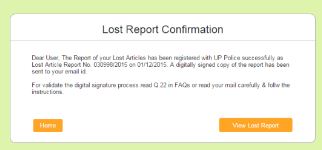
- Save the acknowledgement or report number. Download the report or retrieve it using the portal's registered-report facility if available.
In the earlier version of the service, users selected a web version, registered with mobile and email OTP, entered personal details, incident details and lost article particulars, then received a confirmation number and an electronic report. The archived screenshots below illustrate that workflow; they are not a guarantee of the present interface.
Illustrated steps from the original guide


How to lodge an FIR for a cognizable offence
For theft, assault, cheating or another alleged cognizable offence, provide information to the officer in charge of a police station. You may also use an electronic reporting channel where accepted. The legal process for recording an FIR is governed principally by Section 173 of the Bharatiya Nagarik Suraksha Sanhita, 2023 (BNSS), in force from 1 July 2024.
Section 173 BNSS: Information in cognizable cases
Section 173(1) permits information about a cognizable offence to be given orally or by electronic communication, irrespective of the area where the offence was committed. Electronic information must be signed by the informant within three days for it to be taken on record as prescribed. Oral information must be reduced to writing and read over to the informant. Section 173(2) provides for a free copy of the recorded information to the informant or victim.
Under Section 173(3), a preliminary enquiry may be conducted for certain cognizable offences punishable with imprisonment of three years or more but less than seven years, subject to its statutory conditions, including prior permission from an officer not below Deputy Superintendent of Police and the specified fourteen-day period.
Section 173(4) BNSS: If the police refuse to record information
A person aggrieved by refusal to record information under Section 173(1) may send the substance of that information in writing and by post to the Superintendent of Police concerned. If the conditions are met, the Superintendent may investigate or direct an investigation; the aggrieved person may thereafter apply to the Magistrate in accordance with the law.
Other relevant provisions
- Section 174 BNSS: Information relating to non-cognizable offences and the procedure for their investigation.
- Section 175 BNSS: Police powers to investigate cognizable cases and related Magistrate powers.
- Section 176 BNSS: Procedure for investigation, including prescribed steps following receipt of information.
- Section 193 BNSS: Police report on completion of investigation and communication of investigation progress to the informant or victim within the statutory framework.
Read the official BNSS, 2023 full text on India Code. For older matters, the former Code of Criminal Procedure, 1973 may remain relevant under applicable savings and transitional provisions.
Lost documents and articles: information to keep ready
The following list retains the principal categories covered in the earlier guide. Fields depend on the current portal. Avoid disclosing full bank or identity numbers unnecessarily.
| Article or document | Useful information |
|---|---|
| Aadhaar card | Card number and issuing details, if available |
| Bank account book or passbook | Bank name and relevant identifying details |
| Admit card | Number and institution |
| ATM, debit or credit card | Card type, bank and masked card number |
| Bank draft or cheque | Bank and instrument number |
| Camera, computer or laptop | Manufacturer, serial number and description |
| Driving licence | Licence number and issuing authority |
| Fixed deposit receipt | Bank and receipt details |
| Identity or institutional document | Document number and institution |
| iPad, iPod or tablet | Device identifiers, make and colour |
| Mobile phone | IMEI, mobile number, manufacturer |
| PAN card | PAN details where necessary |
| Passport | Passport number and issuing office |
| Ration card | Card number and issuing authority |
| Video camera | Serial number and manufacturer |
| Voter ID card | EPIC number and issuing details |
| Other article | Description and available identifying particulars |
If an article does not appear in the portal list, select Others where available and describe it accurately.
UPCOP mobile application
The official UP Police website identifies UPCOP as its citizen services application for Android and iOS, including lost article reporting and FIR status. Follow the official UPCOP app links instead of relying on an old app-store listing. The earlier guide linked to a legacy UP Police Lost Report Android app listing; its continued availability is not confirmed.
Frequently asked questions
Is an online lost report the same as an FIR?
No. A lost article report records a reported loss; an FIR concerns information about a cognizable offence recorded under the law.
Can I report theft through the lost article facility?
Suspected theft should be reported as a criminal offence to the police rather than as an unexplained loss.
Can an FIR be reported electronically?
Yes. Section 173 BNSS recognises information by electronic communication, subject to the prescribed signing requirement and other legal conditions.
How can I track a registered FIR?
Use the citizen services available on the official UP Police website or read the UP Police FIR status guide.
Related Indian case law resources
- Hindu Marriage Act case laws
- Divorce Act case laws
- Domestic Violence Act citations
- Maintenance under Section 125 CrPC
- Section 498A IPC judgments
- CrPC case laws
- CPC case laws
- IPC case laws
- Perjury case laws
- Maintenance decisions
General legal information only. Police services, eligibility and court procedures may change. Confirm current requirements through official sources.